What Was the Louisiana Purchase and Why Did It Matter?
4 min read
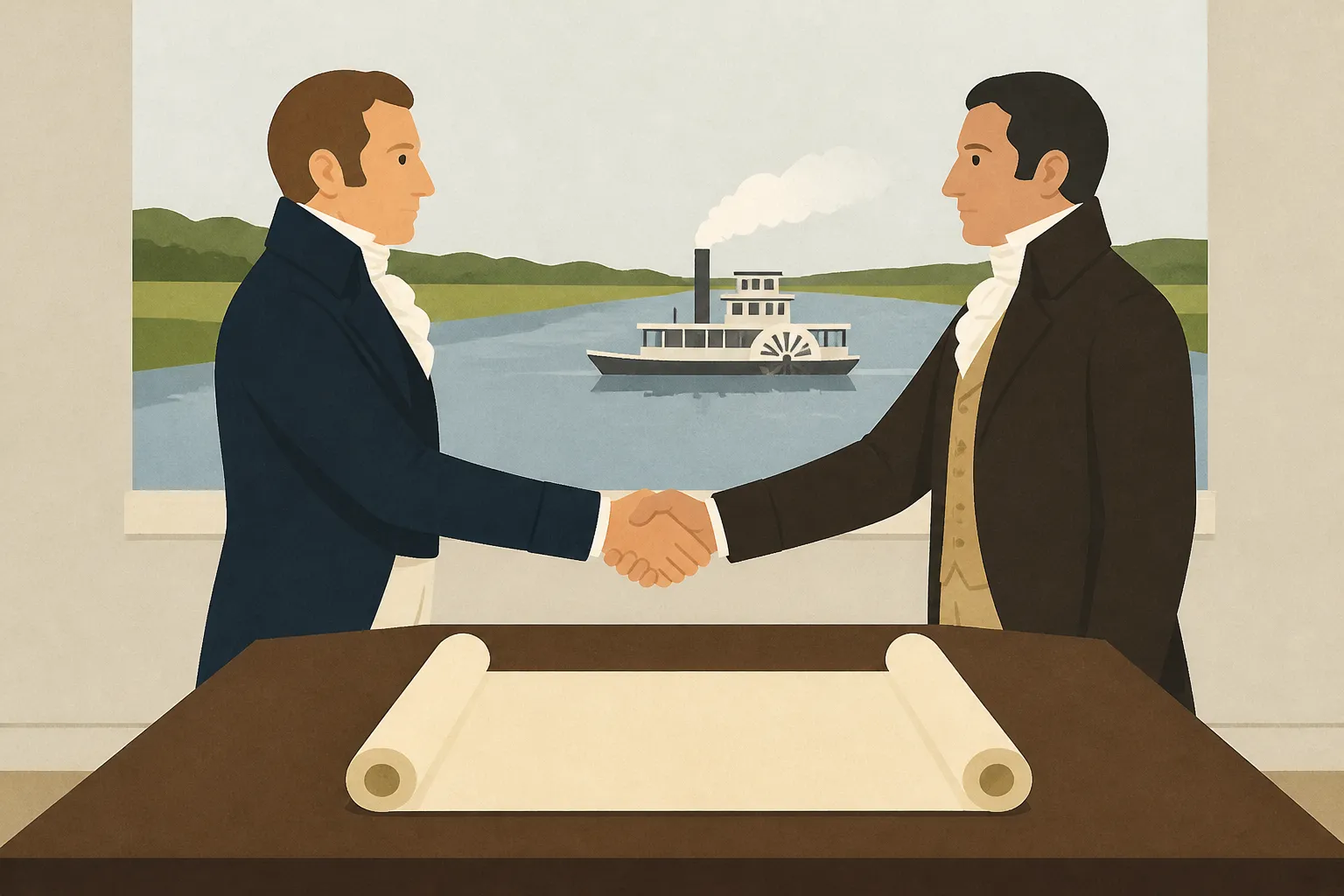
In 1803 the United States agreed to buy the Louisiana Territory from France for about 15 million dollars. The land stretched from the Mississippi River to the Rocky Mountains, roughly 828,000 square miles, and it nearly doubled the size of the country. The purchase is often told as a bargain, but the story involves war, revolution, constitutional doubts and the Native nations who already lived there.
What was the Louisiana Territory?
The name meant the huge region drained by the western tributaries of the Mississippi. It had been claimed by France, passed to Spain in 1762 and was secretly returned to France in 1800, when Napoleon Bonaparte wanted to rebuild a French empire in North America. Spanish officials still ran New Orleans, the port at the mouth of the Mississippi, which was vital for American farmers who shipped goods down the river.
Why did Jefferson want to buy New Orleans?
President Thomas Jefferson worried that a strong France would control the river and block American trade. In 1802 Spanish officials had closed the right of deposit at New Orleans, which let Americans store goods there, and Westerners were angry. Jefferson sent James Monroe to Paris in 1803 to join Robert Livingston, the American minister, with authority to buy New Orleans and nearby land for up to about 10 million dollars.
Why did Napoleon sell the whole thing?
Napoleon's plans for a North American empire depended on the Caribbean colony of Saint-Domingue, now Haiti, which was a very rich sugar island. A revolution of enslaved people, led by Toussaint Louverture and later by Jean-Jacques Dessalines, defeated a French army that was also weakened by yellow fever. Without Saint-Domingue, Louisiana lost much of its value to France. At the same time, war with Britain was about to resume, and Napoleon needed money and wanted to keep Britain from seizing the territory. So the French foreign minister, Talleyrand, surprised the Americans by offering the whole territory.
What did the deal include?
The treaty was signed in Paris in April 1803 and sold the land for 15 million dollars, which came to a few cents an acre. The Senate approved it in October, and the United States took formal control in December 1803 in ceremonies at New Orleans. The deal reached the area of what became fifteen states in whole or in part.
Was it constitutional?
Jefferson, who believed in a limited reading of the Constitution, had doubts, since the document does not clearly authorize the government to buy foreign territory. He considered an amendment, but advisers urged him to act quickly before Napoleon changed his mind, and he went ahead using the government's treaty power. The decision set a precedent for a broad use of federal power.
What about the people who already lived there?
The land was not empty. Many Native nations, including the Osage, Mandan, Lakota and others, lived and traded there, and French and Spanish settlers and enslaved Africans lived in the towns. France sold only its claim to sovereignty, not the Indigenous peoples' own rights. Later, the United States pressured and removed Native nations, an outcome tied to events such as the Trail of Tears.
What did Lewis and Clark do?
Jefferson sent Meriwether Lewis and William Clark to explore the new lands and beyond, to the Pacific. Their expedition, from 1804 to 1806, mapped rivers, recorded plants, animals and peoples and relied on guides and interpreters such as Sacagawea. It also strengthened American claims in the Northwest.
How did the purchase affect slavery?
The new land raised the question of whether slavery would spread west. The debate became sharp in 1819 and 1820, when Missouri applied for statehood, as described in the Missouri Compromise. In that sense the purchase set up some of the political conflict that led toward the Civil War.
Why does it matter?
The Louisiana Purchase gave the United States control of the Mississippi, space for farms and later states, and a strong sense of westward growth. It also shows how events far away, such as a revolution in Haiti, changed American history. Both the opportunity and the cost, for Native peoples and for enslaved people, belong to the story.