What Was the Trail of Tears?
4 min read
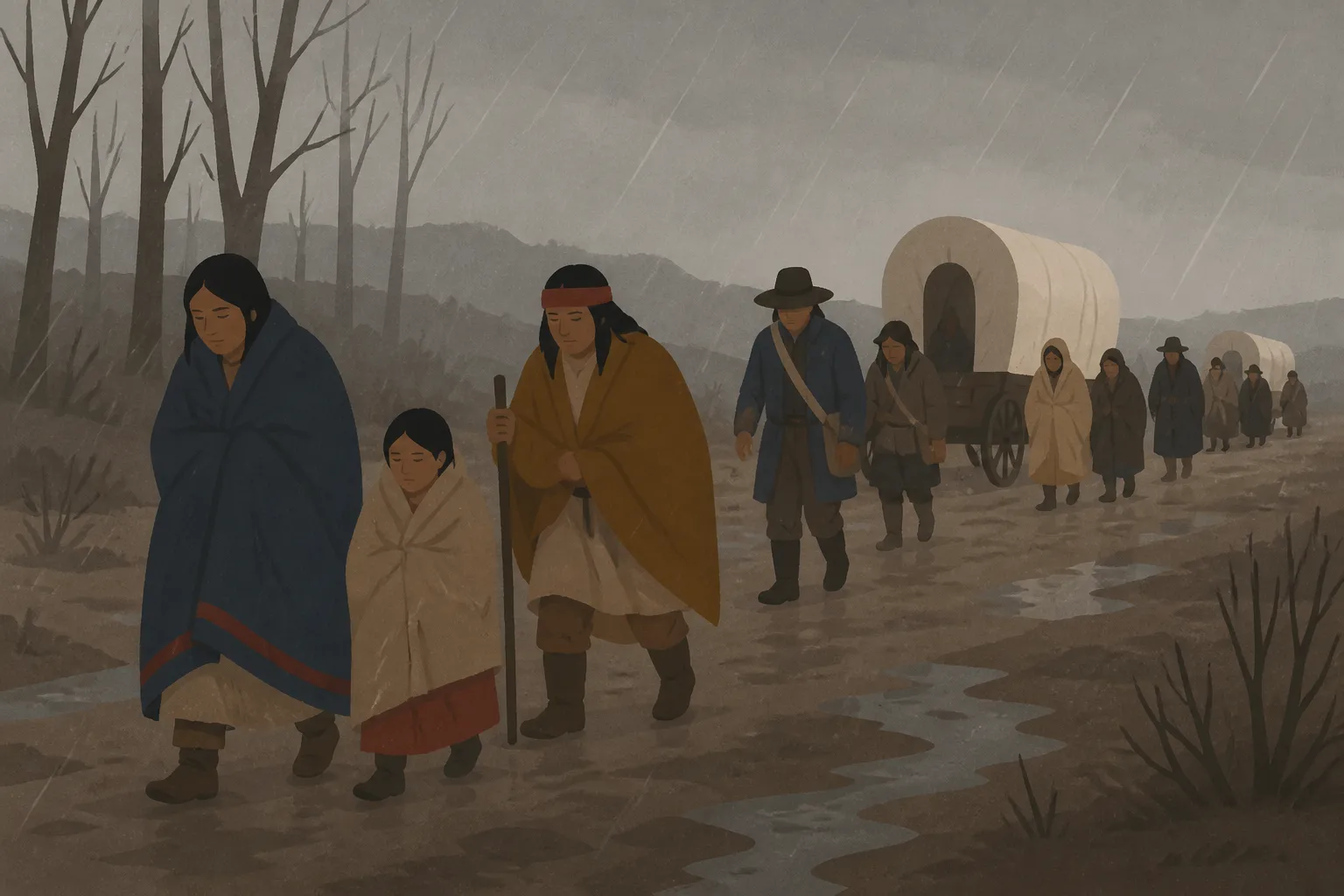
The Trail of Tears is the name for the forced removal of Native American nations from their homelands in the southeastern United States to land west of the Mississippi River during the 1830s. It is most closely tied to the Cherokee, whose march in 1838 and 1839 took thousands of lives, but the Choctaw, Chickasaw, Muscogee (Creek) and Seminole nations were also removed. It was carried out under federal law, and it remains one of the most painful chapters in American history.
What was the Indian Removal Act?
In 1830 Congress passed the Indian Removal Act, which President Andrew Jackson strongly supported. It authorized the president to negotiate treaties exchanging Native lands in the East for territory in the West. Supporters argued that removal would protect Native peoples from conflict with white settlers. Opponents, including some members of Congress and many missionaries, said it was a tool of dispossession. In practice, there was heavy pressure on Native nations, and settlers and state governments wanted their land, especially in Georgia, where gold was found in Cherokee territory in 1828.
Why were the Cherokee a special case?
The Cherokee Nation had adopted a written constitution, a newspaper called the Cherokee Phoenix and a writing system created by Sequoyah. They had also gone to court. In Worcester v. Georgia (1832), the Supreme Court ruled that Georgia could not extend its laws over Cherokee territory. Jackson is often quoted as saying that Chief Justice John Marshall had made his decision and could now enforce it, though historians question the exact words. In practice, the federal government did not enforce the ruling.
How did the removal treaty come about?
In 1835 a small faction of Cherokee leaders signed the Treaty of New Echota, which gave up the nation's eastern lands. Most Cherokee, led by Principal Chief John Ross, rejected it, and about sixteen thousand of them signed a petition against it. The Senate nevertheless ratified the treaty in 1836 by a single vote, and the Cherokee were given two years to leave.
What happened during the removal?
In 1838 the army, under General Winfield Scott, rounded up Cherokee families and held them in camps called stockades before the journey. In the summer heat and then the winter cold, groups traveled west by land and water, many on foot, with too little food, clothing and shelter. Disease and exposure killed many people. A commonly cited estimate is that about four thousand Cherokee died, although researchers differ on the number. The Cherokee phrase for the journey is often translated as "the place where they cried" or "the trail where they cried."
What about the other nations?
The Choctaw were the first to be removed under the new law, in 1831 to 1833, and their journey was marked by cold, hunger and confusion. The Muscogee (Creek) removal, which followed a war in 1836, involved forced marches, some in chains. The Chickasaw were removed after selling their lands, and the Seminole in Florida fought a long war of resistance, the Second Seminole War, and some remained in Florida. In total, tens of thousands of people were moved, and thousands died.
What did removal do to Native nations?
The nations rebuilt their governments and communities in what was then called Indian Territory, now Oklahoma, but they lost homes, farms, cemeteries and sacred places. The removals also broke apart families, and the memory of the journey is central to Cherokee, Choctaw and other nations' history today. The Cherokee Nation and the Eastern Band of Cherokee, descended from those who stayed in North Carolina, still exist.
How does it connect to other events?
Removal came after the vast western lands bought in the Louisiana Purchase opened space where the government planned to send Native nations. It also took place alongside the growth of slavery in the Deep South, since cotton planters wanted the rich Native lands. These land pressures are part of the background to what caused the American Civil War.
How is it remembered?
In 1987 Congress designated the Trail of Tears National Historic Trail, which the National Park Service administers, and the Cherokee Nation and other nations hold events to remember the journey. Historians and Native leaders also stress that the history is not only one of loss but of survival and of nations that continue to govern themselves.